
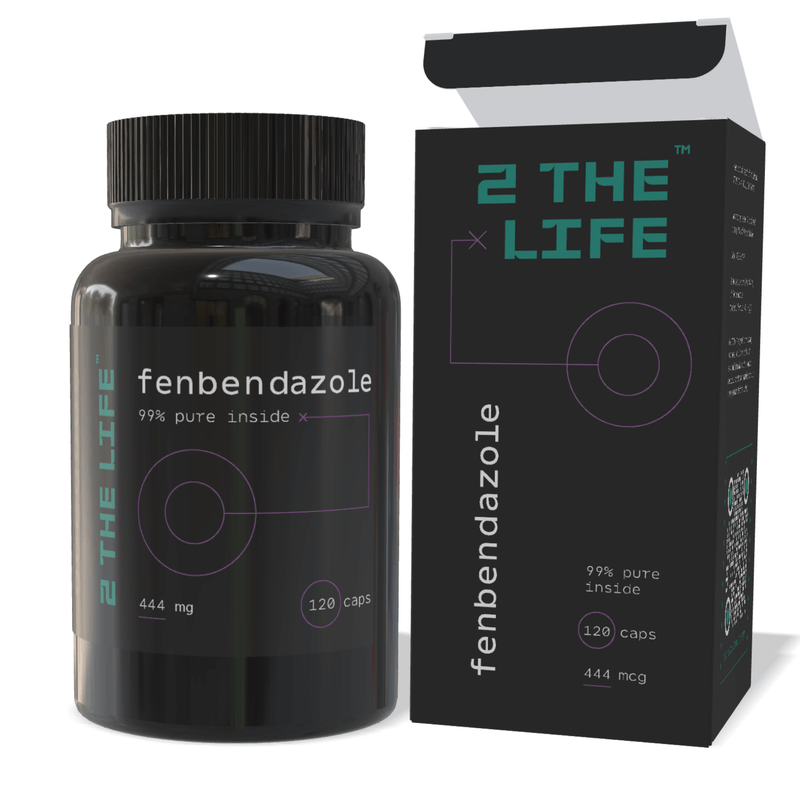
Fenbendazole
Fenbendazole 444 mg — 120 Capsules (99% Purity)
Product Details
Fenbendazole 444mg Capsules — High-Dose Protocol
Fenbendazole is a broad-spectrum benzimidazole anthelmintic with a long-established record in veterinary medicine and a rapidly growing body of human research. Originally developed and approved for use in dogs, cats, horses, and livestock, fenbendazole has attracted significant scientific interest over the past decade for its potential applications in human health — particularly oncology research. Each capsule in this product contains 444 mg of pharmaceutical-grade fenbendazole powder at 99.36% purity. The 444 mg dose is designed for higher-dose research protocols — double the standard 222 mg Tippens dose — suitable for individuals and researchers exploring elevated fenbendazole dosing regimens.
Mechanism of Action
Fenbendazole exerts its effects through multiple complementary pathways, which has driven interest in its potential beyond veterinary antiparasitic use:
- Microtubule disruption via β-tubulin binding: Fenbendazole binds selectively to β-tubulin and disrupts microtubule polymerization — preventing formation of the mitotic spindle required for cell division. This is the same fundamental mechanism employed by several established chemotherapy agents; vinca alkaloids (e.g., vincristine, vinblastine) inhibit tubulin polymerization, while taxanes (e.g., paclitaxel) stabilize microtubules — both ultimately disrupting mitosis. Fenbendazole operates through the same target class.
- Glucose uptake inhibition: Fenbendazole moderately interferes with GLUT transporter function, reducing glucose uptake in both parasites and certain cancer cell lines. Cancer cells rely heavily on aerobic glycolysis (the Warburg effect) and are particularly sensitive to glucose deprivation.
- p53 stabilization: Research has demonstrated that fenbendazole can stabilize and activate p53 — a critical tumor suppressor protein that triggers apoptosis (programmed cell death) in damaged or abnormal cells. Many cancer cells exhibit dysregulated p53 pathways.
- Proteasomal interference: Fenbendazole has been shown to interfere with proteasomal function, disrupting the cellular protein degradation machinery that cancer cells depend on for survival and proliferation.
Anticancer Research
Interest in fenbendazole as a potential anticancer compound accelerated dramatically following the public account of Joe Tippens, a US patient diagnosed with stage 4 small cell lung cancer in 2016. Given a terminal prognosis, Tippens began a self-administered fenbendazole protocol alongside standard treatment. By 2018, his cancer was reportedly in complete remission, an outcome he attributed in part to fenbendazole. His story spread widely online and in South Korean media, spurring a wave of patient interest and prompting formal scientific investigation.
Peer-reviewed research on fenbendazole's anticancer properties includes:
- Dogra et al., 2018 (Scientific Reports): Demonstrated that fenbendazole causes mitotic arrest and apoptosis in human non-small cell lung cancer (NSCLC) cells. The study identified the triple mechanism of p53 stabilization, microtubule disruption, and interference with glucose metabolism as contributing to cancer cell death.
- Florio et al., 2019: Investigated fenbendazole's effects in glioblastoma (GBM) — one of the most treatment-resistant brain cancers — showing antiproliferative effects in glioblastoma cell models.
- Song et al., 2022: Contributed to the growing body of work examining fenbendazole in combination with other agents, consistent with the repurposed drug paradigm.
- Additional published studies have explored activity in colorectal cancer, ovarian cancer, and prostate cancer cell lines and animal models.
Fenbendazole is being actively studied as a repurposed drug — a compound already known to be safe in animals and with a well-characterized toxicity profile, evaluated for new indications alongside standard oncology treatments. It is not an approved cancer treatment in humans, and research is ongoing.
Veterinary Uses
Fenbendazole remains one of the most widely used and trusted broad-spectrum dewormers in veterinary practice worldwide. It is effective against:
- Dogs: Roundworms (Toxocara canis), hookworms (Ancylostoma, Uncinaria), whipworms (Trichuris vulpis), certain tapeworms (Taenia spp.), giardia, and lungworms.
- Cats: Roundworms (Toxocara cati), hookworms, giardia.
- Horses: Strongyles, ascarids, pinworms, and other equine intestinal parasites.
- Livestock and exotic animals: Widely used across species for gastrointestinal nematode infections.
The standard veterinary dosing guideline for dogs is approximately 50 mg per kg of body weight per day for 3 consecutive days. At 444 mg per capsule, this product offers convenient dosing for larger animals.
Human Research Dosage Protocols
The most widely cited off-label human research protocol is the "Tippens Protocol" at 222 mg/day (3 days on / 4 days off). The 444 mg formulation supports higher-dose protocols:
- Standard Tippens Dose: 222 mg/day — achievable with half a 444 mg capsule or by using the 222 mg product
- Higher-Dose Protocol: 444 mg/day (1 capsule of this product) — double the standard Tippens dose, explored in some research contexts and for larger individuals
- Schedule: Typically 3 days on, 4 days off (weekly cycling) to reduce hepatic burden
Higher doses may be associated with greater antiparasitic effect and potentially more pronounced cellular activity, but also carry a higher likelihood of side effects, particularly elevated liver enzymes. Liver function monitoring is strongly recommended for any extended protocol, and especially at 444 mg doses.
Always consult a qualified healthcare provider before beginning any off-label protocol. This product is not intended to diagnose, treat, cure, or prevent any disease.
Product Details
| Active Ingredient: | Fenbendazole 444 mg per capsule |
| Purity: | 99.36% (verified by independent US lab) |
| Count: | 120 capsules per bottle |
| Capsule Type: | Gelatin capsule, no unnecessary fillers |
| Origin: | Ships from Florida, USA |
| Shipping: | Free shipping on every order with tracking |
| Return Policy: | 30-day refund policy |
Safety & Side Effects
Fenbendazole has a well-established safety profile developed over decades of veterinary use. At the 444 mg high-dose level, users should exercise additional caution:
- Mild gastrointestinal effects (nausea, loose stools, diarrhea) may occur, particularly when starting use. These are more common at higher doses.
- Elevated liver enzymes (transaminases) have been reported with prolonged use, and the risk increases with higher doses. Liver function monitoring (LFTs) is strongly recommended for anyone using 444 mg fenbendazole on an extended basis.
- The 3-days-on / 4-days-off cycling protocol is in part designed to reduce hepatic burden and is particularly important at higher doses.
- Not recommended for use during pregnancy or breastfeeding without medical supervision.
- If you are on prescription medications or undergoing cancer treatment, consult your oncologist or physician before use — potential drug interactions should be evaluated.
Frequently Asked Questions
What is fenbendazole?
Fenbendazole is a broad-spectrum benzimidazole anthelmintic — a class of compound originally developed for veterinary use to treat parasitic worm infections in animals. It has a decades-long safety record in dogs, cats, horses, and livestock. In recent years, it has attracted substantial scientific interest for potential applications in human oncology research, following both anecdotal reports and published in vitro and animal studies demonstrating anticancer properties.
Why choose the 444 mg dose over 222 mg?
The 444 mg capsule provides double the fenbendazole of the standard 222 mg Tippens Protocol dose in a single capsule. This formulation is useful for higher-dose research protocols, larger individuals, or veterinary use with larger animals where greater amounts of fenbendazole are required per dose. Anyone unsure of which dose to use should start with the standard 222 mg protocol and consult a healthcare provider before increasing.
How does fenbendazole work against cancer cells?
Research suggests fenbendazole acts on cancer cells through several mechanisms: disrupting microtubule polymerization by binding to β-tubulin, moderately inhibiting glucose uptake, stabilizing p53, and interfering with proteasomal function. This multi-pathway activity is one reason fenbendazole has attracted significant research interest as a potential repurposed oncology compound.
Is fenbendazole safe for humans at 444 mg?
Fenbendazole has a strong veterinary safety record and is generally considered well-tolerated at research protocol doses. At the 444 mg level, the risk of gastrointestinal side effects and elevated liver enzymes is higher than at the 222 mg standard dose. Regular liver function testing is strongly recommended. Fenbendazole is not FDA-approved for human use.
Can I buy fenbendazole without a prescription?
Yes, fenbendazole is available over the counter and does not require a prescription. Our 444 mg capsules ship directly from Florida with free delivery on every order. We strongly encourage consulting a healthcare provider before beginning any off-label high-dose protocol.
Customer reviews
Be the first to review this product.