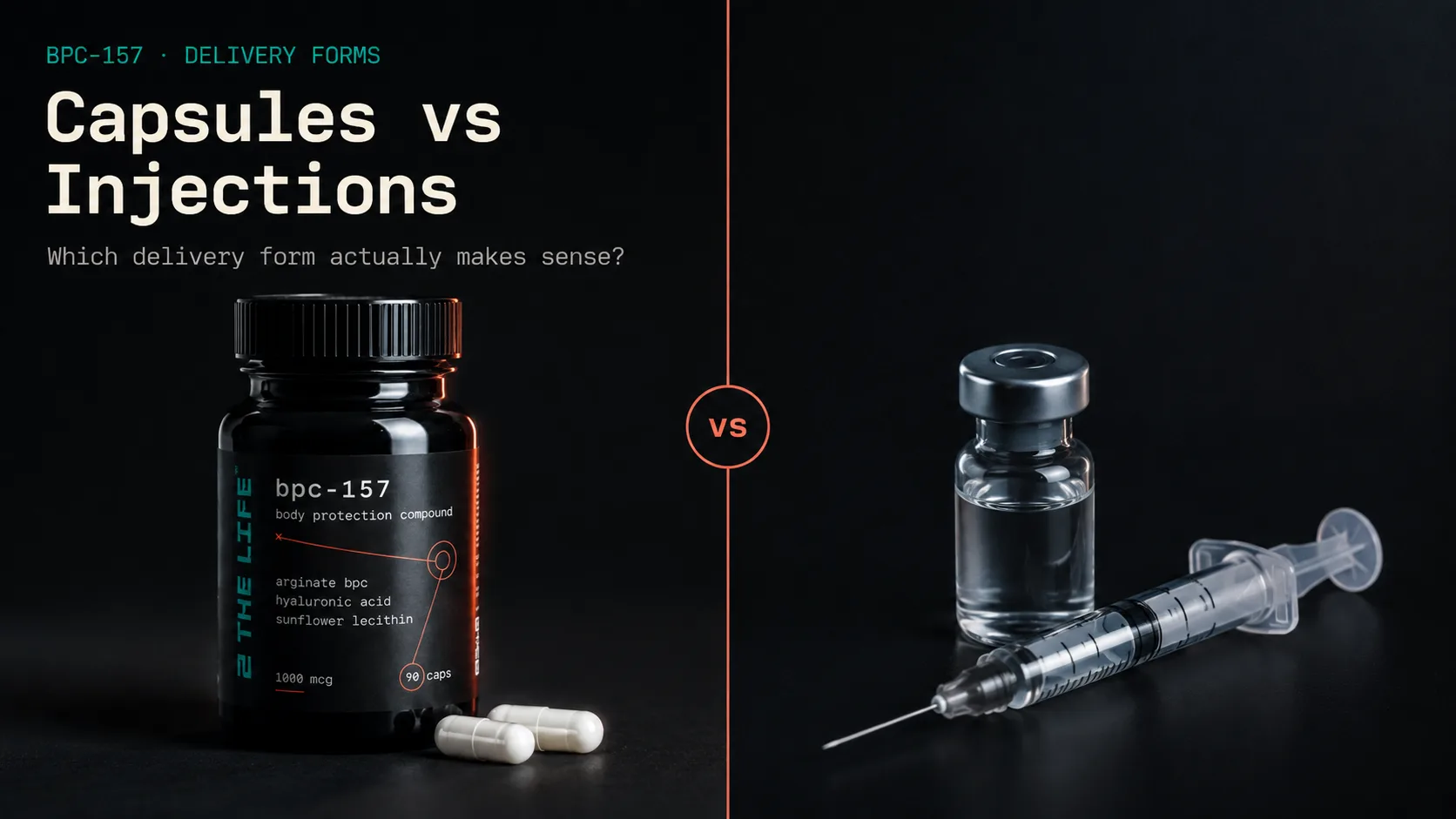
If you've been researching BPC-157, you've probably run into the same debate everyone encounters: capsules or injections? Which method is more effective? Which is safer? For the vast majority of people seeking to use BPC-157 for joint support, gut health, or general recovery, capsules are not just "good enough" — they're the biologically appropriate choice. This article breaks down the pharmacokinetics, safety data, and practical considerations behind both delivery methods so you can make an informed decision.
What Is BPC-157?
BPC-157 (Body Protection Compound-157) is a synthetic pentadecapeptide — a chain of 15 amino acids — derived from a partial sequence of a protective protein found naturally in human gastric juice. This origin is significant: much of the peptide's most well-documented activity relates to the gastrointestinal tract, where it appears to accelerate mucosal healing, protect against ulceration, and regulate the gut-brain axis. Since its early characterization in the 1990s and 2000s, researchers have expanded their investigation into systemic effects, documenting activity in several body systems:
- Tendon and ligament repair — accelerated healing through angiogenesis (new blood vessel formation) and increased collagen synthesis at the site of injury
- Gut healing — protection from NSAID-induced ulcers, reduction of intestinal permeability ("leaky gut"), and modulation of inflammatory bowel markers
- Joint and cartilage support — stimulation of collagen type II synthesis and reduction of pro-inflammatory cytokines implicated in cartilage breakdown
- Muscle recovery — fibroblast activation and ERK1/2 signaling pathway engagement, both important in tissue remodeling after strain injury
- Neuroprotection — modulation of the nitric oxide (NO) system in animal models of traumatic brain injury and neurotoxicity
Much of the foundational animal research on BPC-157 comes from the lab of Predrag Sikiric and colleagues in Croatia, whose extensive body of work on the "brain-gut axis" and pentadecapeptide cytoprotection has shaped how researchers think about the compound's healing properties [1]. For a deeper dive into the underlying mechanisms and the current state of the research literature, see our companion piece: BPC-157 Science, Research & Evidence.
Injections: High Bioavailability, but Significant Tradeoffs
On paper, injectable BPC-157 looks like the superior option. Subcutaneous or intramuscular injection bypasses the digestive tract entirely, delivering the peptide directly into systemic circulation. Estimates place injectable bioavailability at roughly 80–95%, with peak blood concentrations reached within 15–30 minutes. For a molecule that researchers once assumed would be rapidly degraded by stomach acid and digestive enzymes, injection seemed like the obvious workaround.
But bioavailability is only half the story. The other half is what you're actually injecting.
Note: BPC-157 for injection does not exist as a pharmaceutical product. There is no FDA-approved, GMP-manufactured, pharmacy-grade BPC-157 injectable currently on the market anywhere in the world.
Every injectable BPC-157 product sold today originates from research-chemical suppliers or compounding pharmacies operating in a regulatory gray zone. Because these products are not subject to the same manufacturing standards as approved pharmaceuticals, independent laboratory testing of unregulated samples has repeatedly turned up serious quality issues, including:
- Bacterial endotoxins — remnants of bacterial cell walls from the manufacturing process that, when injected, can trigger fever, inflammation, or in severe cases septic shock
- Heavy metal contamination — trace metals introduced during peptide synthesis or purification
- Residual solvents — organic solvents used in synthesis that were not fully removed before packaging
- Microbial contamination — bacterial or fungal growth in improperly sterilized vials
- Incorrect amino acid sequences — meaning the vial doesn't actually contain BPC-157 at all, but a related or entirely unrelated peptide fragment
Beyond the product-quality issue, injectable use introduces a layer of technical burden that many people underestimate. Proper use requires sterile reconstitution of lyophilized (freeze-dried) powder, precise dosing with an insulin syringe, rotation of injection sites to avoid lipohypertrophy or scarring, refrigerated cold-chain storage, and the ability to recognize early signs of localized infection or systemic reaction. Mistakes at any step — a contaminated vial, an unsterile needle, an air bubble, an infected injection site — carry real consequences.
Regulatory scrutiny has also intensified. Several compounding pharmacies producing injectable BPC-157 have faced FDA enforcement action, reflecting broader concerns from regulators about peptides marketed for injection without appropriate safety and efficacy data [4]. This regulatory uncertainty means the injectable supply chain could shift or disappear with little notice, leaving users without consistent access or recourse.
Capsules: The Safer, Smarter Choice for Most People
Rethinking the "Absorption Problem"
The most common criticism of oral BPC-157 is that it has low systemic bioavailability — often cited at around 3% for standard acetate-form capsules. On the surface, this sounds like a dealbreaker. But this framing misses a crucial point: for the most common use cases, that low systemic number isn't actually the metric that matters.
If your primary goal is supporting gut healing — addressing leaky gut, inflammatory bowel symptoms, NSAID-induced gastritis, or general digestive lining integrity — you don't need the peptide to travel through the bloodstream to distant tissues. You need it to make direct contact with the gastrointestinal mucosa. Oral administration puts the peptide exactly where gut-healing activity occurs, making it the biologically optimal delivery route for this application, not a compromise.
For those seeking more systemic exposure — for tendon, ligament, or joint support where the target tissue is outside the GI tract — formulation matters enormously. Arginate salt forms of BPC-157 are engineered to be acid-stable, allowing them to survive the stomach's harsh pH and reach the small intestine intact. Some manufacturer and formulation data suggest these acid-stable forms can achieve systemic bioavailability as high as 90%, a figure that rivals or exceeds injectable delivery while avoiding the sterility and contamination risks described above.
What Human Data Actually Shows
Human clinical data on BPC-157 remains limited relative to the animal literature, but the picture is beginning to fill in — and notably, the most robust human data available to date comes from oral administration, not injection.
In 2024–2025, OvationLab conducted an open-label pilot study involving 101 adults living with chronic pain. Participants took 500 mcg of oral BPC-157 twice daily (1,000 mcg total per day) over an extended observation period. The results showed statistically significant improvements across several patient-reported outcomes, including pain intensity, functional impact on daily activities, and overall quality of life. Critically, the study reported zero adverse events across the full cohort [2]. While an open-label design without a placebo arm has clear limitations, a 101-person safety and efficacy signal is meaningfully larger than most peptide research available to consumers today.
Separately, a poster presented at the American College of Gastroenterology (ACG) Annual Meeting in 2025 highlighted oral BPC-157 as "an emerging adjunct to treat gut permeability," reflecting growing clinical interest in the compound's role in digestive barrier function [3]. This kind of professional-conference visibility signals that oral BPC-157 is increasingly being taken seriously in gastroenterology circles specifically because of its oral route of administration, not despite it.
For a broader review of the preclinical and emerging clinical evidence base, see our detailed research summary: BPC-157 Science, Research & Evidence.
BPC-157 + Hyaluronic Acid: Built for Joint Support
One of the more interesting developments in oral BPC-157 formulation is combining the peptide with hyaluronic acid (HA), a naturally occurring glycosaminoglycan that plays a central role in joint lubrication and cartilage hydration. These two compounds address joint health from different, complementary angles:
| Component | Role |
|---|---|
| BPC-157 | Structural repair — collagen synthesis, angiogenesis, fibroblast activation |
| Hyaluronic Acid | Lubrication — synovial fluid support, cartilage hydration |
| Together | Comprehensive joint support: both repair and function |
This pairing reflects a broader principle in peptide-based joint support: repair and lubrication are not interchangeable functions. BPC-157's proposed mechanisms center on encouraging the body's own reparative processes — new vessel growth to deliver nutrients to injured tissue, and collagen deposition to rebuild structural integrity. Hyaluronic acid, by contrast, does not repair tissue directly; it improves the mechanical environment in which repair and daily joint function occur by maintaining the viscosity and cushioning properties of synovial fluid. Combining the two in a single oral formulation is intended to address both sides of the joint-health equation simultaneously.
Side-by-Side Comparison
| Factor | Oral Capsules | Injections (Off-Market) |
|---|---|---|
| Systemic bioavailability | 3–90% (depends on form) | 80–95% |
| GI bioavailability | Very high (optimal for gut) | Low |
| Contamination risk | Minimal (GMP) | High (unregulated) |
| Infection risk | None | Present |
| Technical requirements | None | Sterile technique |
| Convenience | 1 capsule/day | Daily injection prep |
| Cost over time | Generally lower | Higher (supplies, storage) |
| Regulatory clarity | Sold as supplement | Gray-market / enforcement risk |
| Human trial data | 101 patients (oral) | Limited human data |
Understanding the Pharmacokinetics: Why Route Matters
It's worth pausing on the underlying pharmacology to understand why the capsule-versus-injection debate isn't as simple as "which number is bigger." Bioavailability describes the fraction of an administered dose that reaches systemic circulation unchanged. When a peptide is injected, essentially the entire dose enters the bloodstream, because it skips the digestive tract's enzymatic and acidic environment altogether.
When a peptide is taken orally, it must survive gastric acid, pancreatic proteases, and intestinal enzymes before any of it can be absorbed into the blood. Most unmodified peptides are substantially broken down during this process — this is precisely why insulin, another peptide hormone, is injected rather than swallowed. BPC-157's relative stability compared to many peptides is one of the more interesting aspects of its pharmacology, and it's part of why oral dosing has been feasible at all.
But here's the key nuance: even the amount of peptide that is broken down or does not reach systemic circulation does not necessarily go to waste. As the peptide (or its fragments) travels through the stomach and intestinal lining, it makes direct contact with the very mucosal tissue that much of BPC-157's gut-protective research focuses on. In this sense, "low systemic bioavailability" and "high local/GI bioavailability" can be true at the same time — and for gut-focused applications, the latter is what actually drives outcomes.
Who Should Consider Oral BPC-157?
- People with joint pain, tendinopathy, or chronic musculoskeletal issues looking for a non-invasive supportive option
- People with gut health challenges — leaky gut, IBS-type symptoms, IBD-adjacent concerns, or NSAID-related digestive damage
- Active and athletic individuals wanting recovery support without the complexity, cost, and risk profile of self-injection
- Anyone looking for a long-term, sustainable protocol where consistency, safety, and product quality assurance matter more than maximizing peak blood concentration
- People who are needle-averse or who travel frequently and need a product that doesn't require refrigeration or sterile supplies
Conversely, individuals pursuing BPC-157 exclusively for research purposes under appropriate institutional oversight may have different considerations entirely — but that context is distinct from personal wellness use, which is the focus of this article.
Practical Considerations Beyond Bioavailability
When people compare capsules and injections, the conversation often stops at bioavailability percentages. But several other practical factors deserve equal weight:
Sourcing and Quality Control
Oral BPC-157 sold as a dietary supplement in the United States is subject to Good Manufacturing Practice (GMP) requirements under FDA dietary supplement regulations, including identity testing, contaminant screening, and batch documentation. Injectable products sold through gray-market research-chemical channels are typically not subject to this oversight, which is precisely why independent testing has uncovered the contamination issues described earlier in this article.
Cost and Accessibility
Injectable protocols require ongoing purchases of syringes, alcohol swabs, sharps disposal containers, and refrigerated storage — costs that add up beyond the peptide itself. Capsules eliminate all of these ancillary expenses and can be taken anywhere without special handling.
Adherence
Daily self-injection is a meaningful behavioral barrier for many people, and inconsistent dosing undermines any peptide's potential benefit. A once-daily capsule is far easier to incorporate into an existing supplement routine, which matters for any intervention that requires sustained use to evaluate its effects.
The Bottom Line
The injection debate often gets framed as "more bioavailability = better." But bioavailability is only meaningful in the context of where the compound needs to go. For most conditions people take BPC-157 for — gut lining support, joint and connective tissue support, general recovery — oral capsules deliver the compound exactly where it needs to be, without the contamination risks, technical complexity, or regulatory uncertainty that define today's injectable market. When formulated with acid-stable arginate forms, oral BPC-157 can also achieve systemic exposure competitive with injection, making the case for capsules even stronger across the board.
For readers who want to go deeper into the underlying research, mechanisms of action, and the current clinical evidence landscape, our companion article — BPC-157 Science, Research & Evidence — provides a comprehensive review.
Recommended Products
All products are independently lab-tested for purity (99%+) and ship from the United States.
Frequently Asked Questions
Is BPC-157 FDA-approved?
No. BPC-157 is not FDA-approved for any human indication. It is available as a dietary supplement and research compound. Clinical research is early but promising, with encouraging safety signals from recent human pilot studies.
Are BPC-157 capsules effective, or do I need injections?
For gut health, oral capsules are the biologically optimal route — the peptide reaches the GI mucosal lining directly. For systemic use, acid-stable arginate salt forms can reach up to 90% bioavailability orally. Injections carry contamination risks from unregulated sources and are not currently available as a pharmaceutical-grade product.
What dose of BPC-157 should I take?
The first standardized human trial used 500 mcg twice daily (1,000 mcg total per day). Many oral capsule formulations contain 1,000 mcg per capsule to allow for a convenient once-daily dose matching that total.
Is BPC-157 safe?
The first standardized human study (101 adults) reported zero adverse events with oral BPC-157 at 500 mcg twice daily over an extended period. Oral administration also avoids the contamination risks associated with injectable peptides sourced from unregulated suppliers.
What does BPC-157 do?
BPC-157 has been studied for tendon and ligament repair (via angiogenesis and collagen synthesis), gut healing (protection from ulcers, reduced intestinal permeability), joint support (collagen type II synthesis), muscle recovery, and neuroprotection in preclinical models.
Are injectable BPC-157 products safe?
There is no pharmaceutical-grade injectable BPC-157 product currently on the market. Independent testing of unregulated injectable products has found bacterial endotoxins, heavy metals, residual solvents, microbial contamination, and even incorrect amino acid sequences. Compounding pharmacies producing these products have faced FDA enforcement action.
This content is for informational purposes only and does not constitute medical advice. Consult a qualified healthcare provider before starting any new supplement, especially if you have an existing medical condition or take prescription medication.
References
- Sikiric P, Seiwerth S, Rucman R, et al. "Brain-gut axis and pentadecapeptide BPC 157: theoretical and practical implications." Frontiers in Pharmacology. 2018. pubmed.ncbi.nlm.nih.gov
- OvationLab. "Open-label pilot study: oral BPC-157 in chronic pain (101 adults)." OvationLab Clinical Research, 2024.
- American College of Gastroenterology (ACG) Annual Meeting. "Oral Peptide BPC-157: An Emerging Adjunct to Treat Gut Permeability." 2025.
- STAT News. "BPC-157 safety and regulatory review." 2026.